How to AI-Proof Your Career in the UK: 7 Practical Steps for 2026
You do not need to become a programmer to stay employable as AI spreads. These seven practical steps, from auditing your own tasks to using free government-backed training, will help you stay ahead in the UK jobs market in 2026.
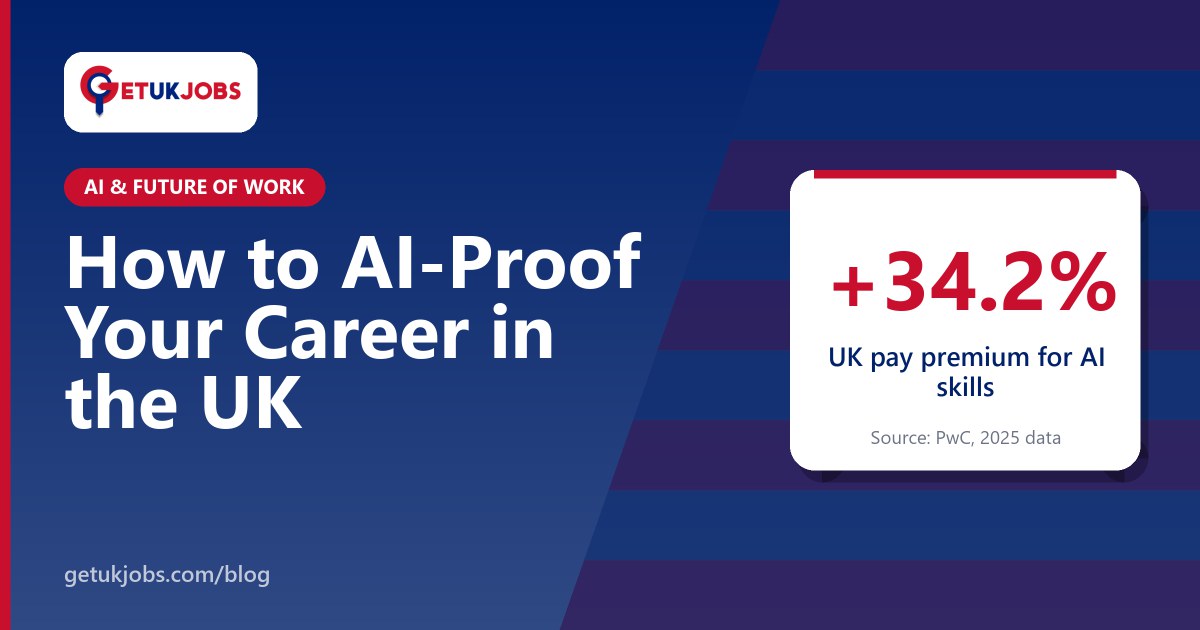
Table of contents
- Step 1: Audit your own job, task by task
- Step 2: Learn the AI tools used in your field
- Step 3: Use the free training on offer
- Step 4: Double down on the skills AI can't copy
- Step 5: Prove it on your CV and in interviews
- Step 6: Consider moving towards growing, less-exposed work
- Step 7: Use AI safely and within the rules
- Which jobs are the most AI-proof in the UK?
- Your next step
- Sources
Last reviewed: 17 October 2026
Short answer: the best way to AI-proof your career in the UK is to become the person in your team who uses AI well, while building the human skills it can't copy. Employers are paying for exactly that: UK workers with AI skills earned a 34.2% wage premium in 2025, up from 11% a year earlier (PwC 2026 UK AI Jobs Barometer). You don't need to learn to code. You need to know which parts of your job AI can do, get good at directing it, and move your effort towards judgement, relationships and responsibility.
Here are seven steps that work whether you're in accounts, admin, marketing, retail management or the public sector.
Key takeaways
- AI skills earned UK workers a 34.2% pay premium in 2025 (PwC, June 2026).
- A government and industry partnership aims to train 7.5 million UK workers in AI skills by 2030, with free training materials (GOV.UK).
- 38% of UK businesses using AI say admin and clerical roles are the most affected (ONS, September 2026).
- The safest move isn't avoiding AI. It's being the person who uses it best in your field.
Step 1: Audit your own job, task by task
Jobs don't disappear in one go; tasks do. Write down what you actually spend a typical week doing, then sort each task into three groups:
- AI can do this now: drafting standard emails, summarising documents, formatting reports, first-pass research, data entry.
- AI can help with this: analysis, writing proposals, preparing presentations, planning.
- AI can't do this: negotiating, managing people, handling a distressed customer, making a call you're accountable for, hands-on practical work.
If more than half your week sits in the first group, your role is exposed and it's time to act. The aim is to shift your week towards the third group, using AI to clear the first.
Step 2: Learn the AI tools used in your field
General chatbots are a start, but employers increasingly want people who know the tools in their own profession. Here's where to focus:
| If you work in… | AI skills worth building |
|---|---|
| Admin and office support | Microsoft Copilot or Google Gemini for email, documents and meeting notes; automating repetitive workflows |
| Finance and accounting | AI features in Xero, Sage and Excel; checking AI-generated reconciliations and forecasts |
| Marketing and content | AI for research, drafts and image generation, with strong editing and brand judgement |
| Customer service | Working alongside AI chat assistants; handling the complex cases they pass on |
| HR and recruitment | AI-assisted screening and scheduling, plus understanding fairness and UK GDPR limits |
| Software and data | AI coding assistants, prompt design, testing and reviewing AI-written code |
Ten focused hours on the tools your industry actually uses will do more for you than a vague online course about "AI in general".
Step 3: Use the free training on offer
You shouldn't have to pay to get started. In 2025 the government launched an AI skills partnership with employers including Google, Microsoft, IBM, BT and Amazon, with a goal of training 7.5 million UK workers by 2030 and training materials offered free of charge (GOV.UK).
Good starting points include the free AI courses from Google, Microsoft Learn and IBM SkillsBuild, plus anything your own employer offers through its learning platform. If you're in England and want a formal qualification, ask about apprenticeships in data, digital or AI: they're open to existing employees, not just school leavers. Scotland and Wales run their own apprenticeship programmes, so check Skills Development Scotland or Apprenticeships Wales.
Step 4: Double down on the skills AI can't copy
As AI handles more routine output, the human parts of work become the job. PwC's research found that jobs most exposed to AI are changing their required skills fastest, with the premium going to people who combine technical fluency with judgement.
In practice, that means getting deliberately better at:
- Judgement: knowing when an AI answer is wrong, incomplete or risky.
- Communication: explaining, persuading, negotiating and presenting.
- Relationships: clients, colleagues and stakeholders trust people, not tools.
- Responsibility: being the person who signs off and is accountable for the result.
Step 5: Prove it on your CV and in interviews
"Proficient in AI" on a CV means nothing. Recruiters want evidence. Write it the same way you'd write any achievement:
"Introduced Microsoft Copilot for meeting notes and first-draft reports, cutting weekly reporting time from six hours to two."
In interviews, have one short story ready about a time you used AI to save time or improve quality, and one about a time you spotted an AI mistake. The second story often impresses more. Our UK CV guide shows how to fit this into a two-page CV.
Step 6: Consider moving towards growing, less-exposed work
If your current role is heavily exposed and you're early in your career, a sideways move can make sense. Roles that combine practical skill or human contact with some technology are in a strong position: healthcare, skilled trades, engineering, teaching, social care and many public services.
Career changers often underestimate how transferable their experience is. An administrator who moves into operations or project coordination, or a customer service lead who moves into training or quality, keeps most of their experience while reducing their exposure to automation.
Step 7: Use AI safely and within the rules
The fastest way to damage your career with AI is to misuse it. Two rules worth sticking to:
- Never paste confidential or personal data into public AI tools unless your employer has approved it. Under UK GDPR, customer and employee data needs proper handling, and a careless prompt can become a data breach.
- Always check the output. AI tools still invent facts, figures and references. You are responsible for what you send, not the tool.
Ask whether your employer has an AI policy. If it doesn't, offering to help write one is itself a good way to stand out.
Which jobs are the most AI-proof in the UK?
No job is completely AI-proof, but some are far more resilient. These are the roles least exposed to AI right now:
- Nursing, midwifery, paramedics and allied health professions
- Social care and early years work
- Electricians, plumbers, gas engineers and other skilled trades
- Construction, engineering and site management
- Police, fire and other emergency services
- Roles built on in-person relationships, such as specialist sales, therapy and coaching
For the bigger picture, see our analysis of how AI is affecting UK jobs in 2026.
Your next step
Pick one task you do every week, learn to do it with an AI tool this month, and write down the time it saves. That single, measurable result will help you more in your next interview than any certificate. Then browse jobs in the UK and notice how many now ask for exactly that kind of experience.
Sources
- PwC, 2026 UK AI Jobs Barometer, 15 June 2026
- GOV.UK, AI skills partnership with industry, 2025
- ONS, Business Insights and Conditions Survey (AI questions), September 2026